# What is Newton? \[Newton Protocol is a decentralized policy engine for onchain transaction authorization, built as an EigenLayer AVS. Enforce spend limits, sanctions screening, fraud prevention, and compliance rules in smart contracts.]
Newton Protocol is a [policy engine](/developers/overview/core-concepts) that lets you encode, verify, and enforce rules — spend limits, sanctions screening, fraud prevention — directly within your smart contracts.
### The problem
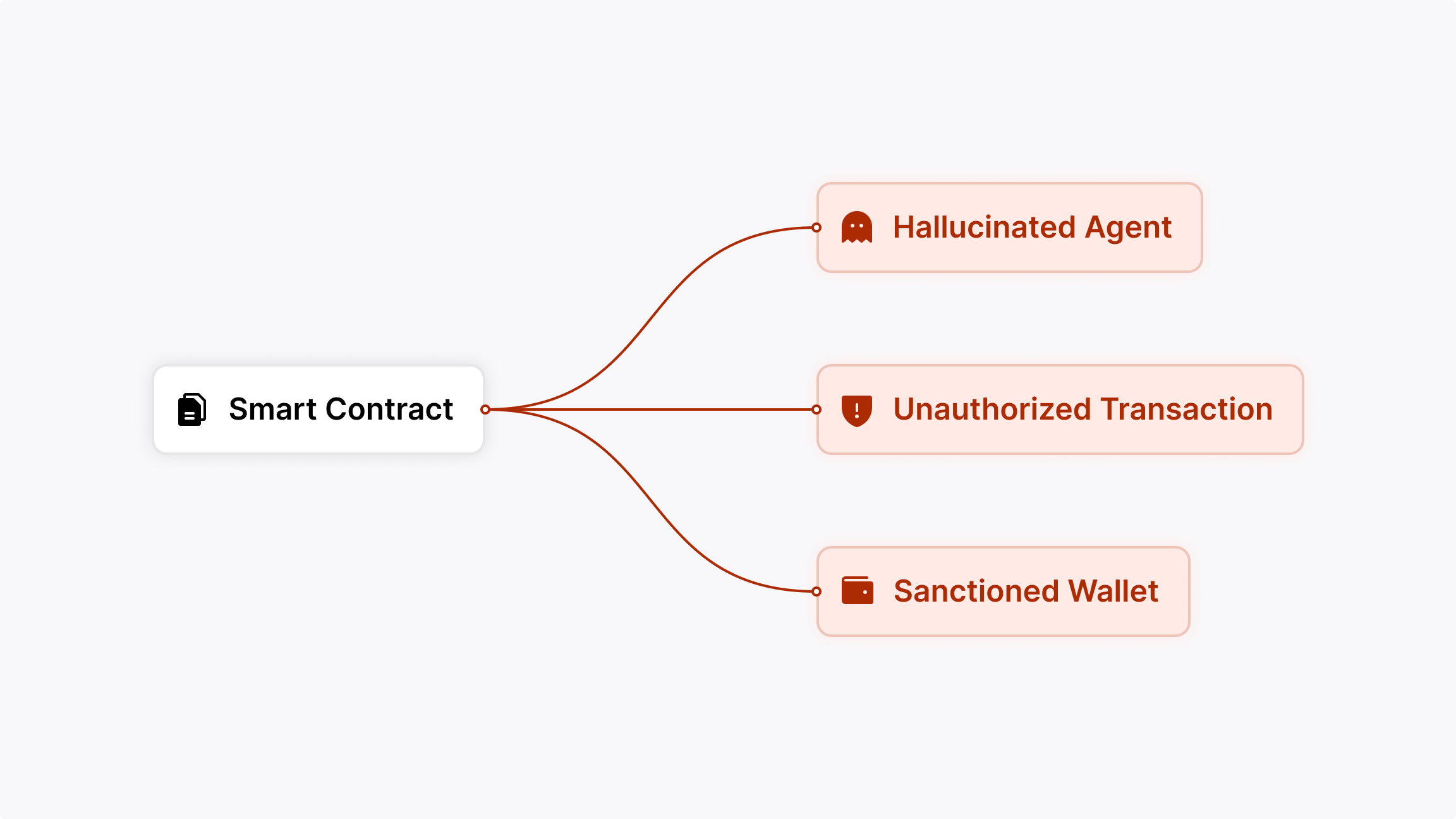 Smart contracts are **blind to offchain context**: whether a user is sanctioned, whether an AI agent is hallucinating, or whether a transaction violates a corporate spend policy. Traditional security relies on frontend filters or centralized API checks, leaving protocols vulnerable to unauthorized actions from third-party aggregators, autonomous agents, or direct contract calls.
### The solution
Smart contracts are **blind to offchain context**: whether a user is sanctioned, whether an AI agent is hallucinating, or whether a transaction violates a corporate spend policy. Traditional security relies on frontend filters or centralized API checks, leaving protocols vulnerable to unauthorized actions from third-party aggregators, autonomous agents, or direct contract calls.
### The solution
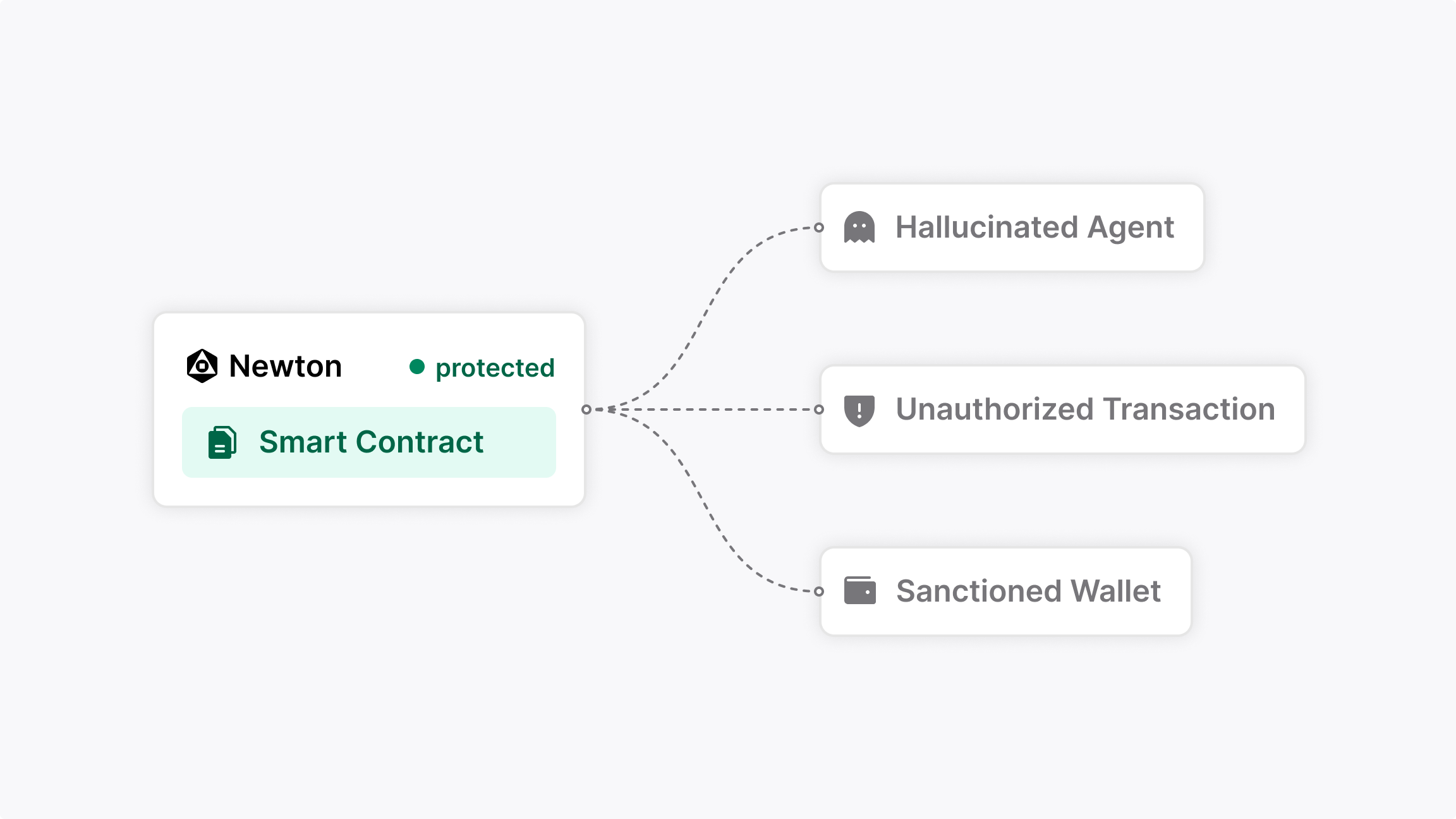 Newton bridges this gap with real-time offchain data — KYC status, market feeds, proof of reserves — evaluated by a [decentralized operator network](/developers/concepts/consensus-security) and enforced at the smart contract level. Your protocol stays protected regardless of where the transaction originates.
### Modular and chain-agnostic
Newton integrates with [most EVM-compatible networks](/developers/concepts/multichain) including Ethereum, Base, and Arbitrum. Non-EVM support is on the roadmap.
See a live example of a Newton-powered sanctions-checked transfer app
Get in touch to discuss your integration or partnership opportunity
## What it looks like
```ts twoslash
import { createWalletClient, http } from 'viem'
import { privateKeyToAccount } from 'viem/accounts'
import { sepolia } from 'viem/chains'
import { newtonWalletClientActions } from '@newton-xyz/sdk'
// ---cut---
async function simulate() {
const client = createWalletClient({
account: privateKeyToAccount('0x' + '1'.repeat(64) as `0x${string}`),
chain: sepolia,
transport: http(),
}).extend(newtonWalletClientActions({ apiKey: 'test-api-key' }))
const sender = '0x0000000000000000000000000000000000000000' as `0x${string}`
const recipient = '0x0000000000000000000000000000000000000001' as `0x${string}`
const calldata = '0x' as `0x${string}`
const policyId = '0x' + '0'.repeat(64) as `0x${string}`
const policyAddress = '0x1234567890123456789012345678901234567890' as `0x${string}`
// Simulate a policy evaluation against a transaction intent
const result = await client.simulateTask({
intent: { from: sender, to: recipient, value: '0x0', data: calldata, chainId: 11155111, functionSignature: '0xa9059cbb' },
policyTaskData: { policyId, policyAddress, policy: '0x', policyData: [] },
})
console.log(result.result?.allow) // true or false
}
```
Run this example end-to-end in 5 minutes
## Walkthrough
## Why Newton
* **Verifiable Trust:** Every compliance decision is backed by a [BLS attestation](/developers/overview/core-concepts#attestation), not reputation.
* **Privacy-Preserving:** Only hashes and commitments are onchain — no PII or sensitive data exposure. See the [privacy layer](/developers/concepts/privacy-layer).
* **Composable:** Works with wallets, dApps, AI agents, and DeFi protocols through a [standard SDK interface](/developers/reference/sdk-reference).
* **Chain-Agnostic:** Newton proofs can be verified across [any supported EVM chain](/developers/concepts/multichain) via lightweight verifier contracts.
* **Extensible:** Supports both open-source policies and enterprise modules for regulated financial institutions.
## Next Steps
Simulate your first policy evaluation in 5 minutes
Understand policies, intents, tasks, and attestations
Newton bridges this gap with real-time offchain data — KYC status, market feeds, proof of reserves — evaluated by a [decentralized operator network](/developers/concepts/consensus-security) and enforced at the smart contract level. Your protocol stays protected regardless of where the transaction originates.
### Modular and chain-agnostic
Newton integrates with [most EVM-compatible networks](/developers/concepts/multichain) including Ethereum, Base, and Arbitrum. Non-EVM support is on the roadmap.
See a live example of a Newton-powered sanctions-checked transfer app
Get in touch to discuss your integration or partnership opportunity
## What it looks like
```ts twoslash
import { createWalletClient, http } from 'viem'
import { privateKeyToAccount } from 'viem/accounts'
import { sepolia } from 'viem/chains'
import { newtonWalletClientActions } from '@newton-xyz/sdk'
// ---cut---
async function simulate() {
const client = createWalletClient({
account: privateKeyToAccount('0x' + '1'.repeat(64) as `0x${string}`),
chain: sepolia,
transport: http(),
}).extend(newtonWalletClientActions({ apiKey: 'test-api-key' }))
const sender = '0x0000000000000000000000000000000000000000' as `0x${string}`
const recipient = '0x0000000000000000000000000000000000000001' as `0x${string}`
const calldata = '0x' as `0x${string}`
const policyId = '0x' + '0'.repeat(64) as `0x${string}`
const policyAddress = '0x1234567890123456789012345678901234567890' as `0x${string}`
// Simulate a policy evaluation against a transaction intent
const result = await client.simulateTask({
intent: { from: sender, to: recipient, value: '0x0', data: calldata, chainId: 11155111, functionSignature: '0xa9059cbb' },
policyTaskData: { policyId, policyAddress, policy: '0x', policyData: [] },
})
console.log(result.result?.allow) // true or false
}
```
Run this example end-to-end in 5 minutes
## Walkthrough
## Why Newton
* **Verifiable Trust:** Every compliance decision is backed by a [BLS attestation](/developers/overview/core-concepts#attestation), not reputation.
* **Privacy-Preserving:** Only hashes and commitments are onchain — no PII or sensitive data exposure. See the [privacy layer](/developers/concepts/privacy-layer).
* **Composable:** Works with wallets, dApps, AI agents, and DeFi protocols through a [standard SDK interface](/developers/reference/sdk-reference).
* **Chain-Agnostic:** Newton proofs can be verified across [any supported EVM chain](/developers/concepts/multichain) via lightweight verifier contracts.
* **Extensible:** Supports both open-source policies and enterprise modules for regulated financial institutions.
## Next Steps
Simulate your first policy evaluation in 5 minutes
Understand policies, intents, tasks, and attestations